This information was highlighted by Dr. Bui Vinh Quang, Director of Hanoi Oncology Hospital, at the hospital’s 25th-anniversary celebration and the Hanoi Cancer Prevention Conference 2025, held on November 6-7 at the National Convention Center.
Speaking at the ceremony, Dr. Bui Vinh Quang stated that, on average, Hanoi Oncology Hospital examines and treats over 300,000 patient visits annually and has implemented numerous advanced and modern techniques. The hospital has synchronously developed five pillars: surgery, internal medicine, combined surgical and internal medicine approaches, nuclear medicine, and palliative care.
Currently, Hanoi Oncology Hospital is a specialized hospital under the Hanoi Department of Health, and also the country’s leading technical specialist hospital in oncology.
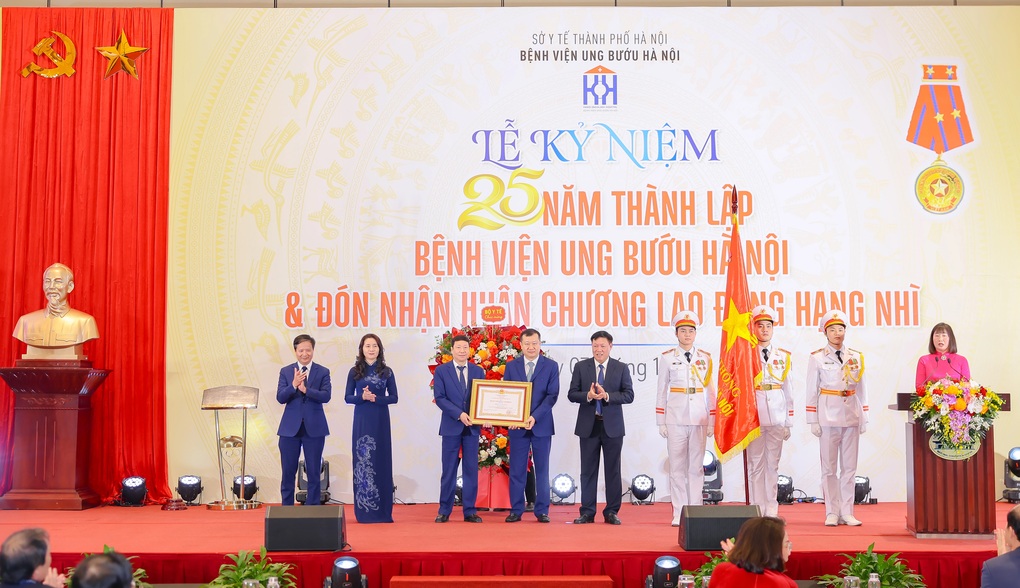 Deputy Minister of Health Do Xuan Tuyen presents the Second-class Labor Order to Hanoi Oncology Hospital representatives, with Dr. Bui Vinh Quang also honored.
The Clinical Research Unit of Hanoi Oncology Hospital has conducted 48 clinical trials, allowing patients free access to many advanced treatment methods and contributing scientific data for public health research.
“The past 25 years have been a journey of relentless effort, perseverance, and dedication from generations of staff at Hanoi Oncology Hospital.
The hospital consistently places patients at the center, science as its foundation, and humanity as its mission. We continuously innovate and improve professional quality, aiming to bring hope and a better quality of life to cancer patients,” emphasized Dr. Bui Vinh Quang.
Deputy Minister of Health Do Xuan Tuyen remarked that after 25 years of development, Hanoi Oncology Hospital has become a leading specialized oncology facility, with over 700 staff members, including 160 doctors, 81% of whom hold postgraduate degrees.
The hospital has invested in many modern equipment such as linear accelerator radiotherapy systems, PET/CT scanners, DSA angiography machines, SPECT scintigraphy, endoscopic surgery, Realtime-PCR testing systems, etc., contributing to improved diagnostic quality and treatment effectiveness.
The Deputy Minister of Health urged the hospital to continue developing a high-tech center for cancer diagnosis and treatment. Concurrently, it should promote training and research, connect oncology systems at all levels, strengthen international cooperation, and accelerate digital transformation.
The Hanoi Cancer Prevention Conference 2025 gathered over 500 experts, presenting 100 scientific reports, including 27 reports from international experts from the United States, France, Italy, Japan, South Korea, Singapore, and India.
The discussions focused on clinical oncology; diagnostic imaging; nuclear medicine; anatomical pathology; palliative care; clinical pharmacy, etc.
Notably, the conference included specialized sessions from the ECHO program (remote capacity building training) and VTOP (multidisciplinary cooperation in cancer treatment), helping to connect the nationwide cancer network.