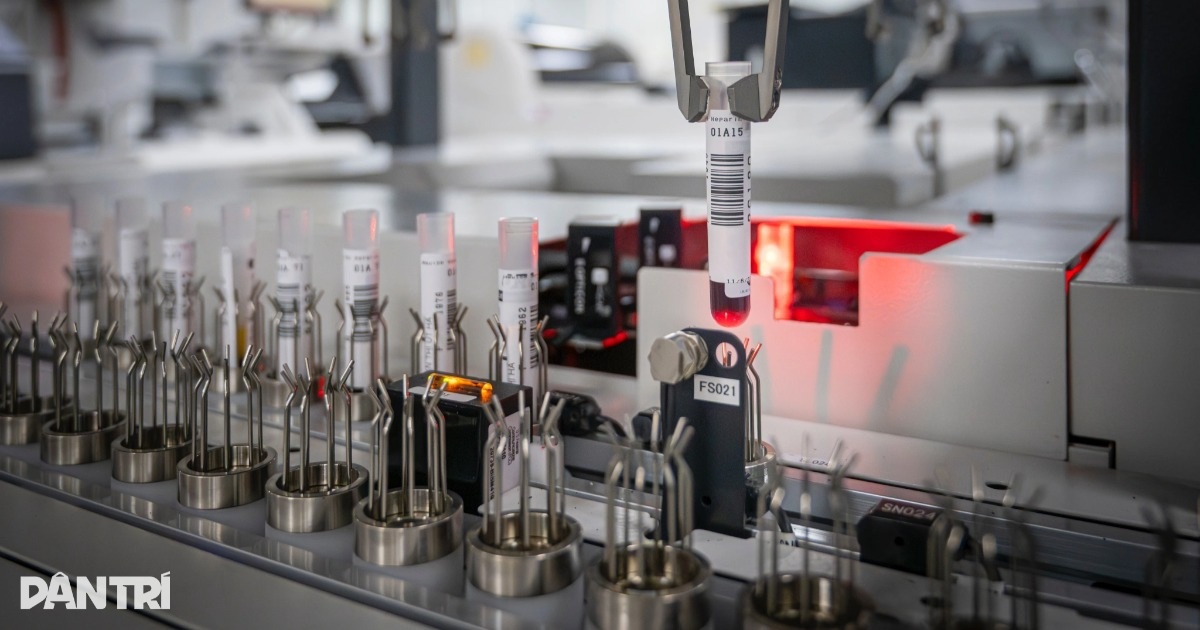
Test tubes line up in an automated system, delivering 20,000 results daily (Video: Minh Nhat – Thuong Huyen).
At Military Hospital 103, blood testing procedures are carried out on a highly “digitalized” and automated system. Each test tube has a unique barcode containing patient information, ensuring accurate sample collection and results.
After collection, samples are transferred to the Department of Biochemistry to begin an almost entirely automated testing cycle.
The fully automated pre-analytical testing system (Automation Power Express) at the Department of Biochemistry, Military Hospital 103, comprises multiple analyzers connected on a single automated processing line.
This is currently one of Vietnam’s most modern automated testing systems.
Hospital departments and wards are equipped with an automated sample transport system, resembling stations and pipelines. After being barcoded, samples are routed directly through these pipelines to the testing laboratory.
Upon receiving samples, laboratory staff enter the barcode on the blood tube into the computer, allowing the system to automatically store patient information and test requests.
The test tubes are then brought by doctors to the sample tube feeder. From this point, the rest of the entire testing process is performed by the automated system.
The tubes are moved into centrifuges. The centrifugation process separates the blood sample into two parts: plasma and blood cell sediment.
After centrifugation, the conveyor line transfers the test tubes to the distributor machine. Depending on the testing purpose, the line directs the sample tubes to biochemical or immunoassay analyzers.
The system returns biochemical test results in 30-45 minutes, while immunoassay test results take a maximum of 2 hours. Previously, patients had to wait 3-4 hours for blood test results.
At a top-tier hospital like Military Hospital 103, the daily volume of samples to be processed is very large. According to Associate Professor Dr. Pham Van Tran, Head of the Department of Biochemistry at Military Hospital 103, Military Medical Academy, implementing an automated testing system shortens testing time and saves human resources.
“Whereas before 10-15 people were needed, now only 5 people can perform the same testing process on the automated system and complete over 20,000 results daily. Laboratory technicians will handle sample entry, operational supervision, and quality control, while doctors perform the final check before releasing results to patients,” said Assoc. Prof. Tran.
Most importantly, with a fully automated analysis system, the laboratory not only saves human resources but also better controls testing quality – a paramount factor in diagnosis and treatment.
Test results are immediately updated to the Laboratory Information System (LIS) and electronic patient records. The LIS prioritizes emergency samples, automatically alerts for faulty samples, manages post-testing specimens, and ensures biosafety.
The software deployed on the laboratory management system also helps doctors control result turnaround times to inform patients as early as possible, based on corresponding display colors: black – not yet tested, yellow – machine is testing, green – results available.
At the end of the testing process, the automated line transfers the sample tubes to a capping system and then to the storage system. Each storage cabinet can hold up to 10,000 specimens, with a maximum storage period of 5 days.
Whenever retesting is required, doctors simply enter the sample code into the machine, and the automated line retrieves the sample from storage and re-performs the analysis as requested.
Beyond routine tests, the laboratory also conducts many specialized biochemical techniques: quantifying hormone levels, cancer markers, cardiovascular markers, diagnosing and treating autoimmune diseases, etc., better serving medical examination and treatment and providing valuable results for medical research.