
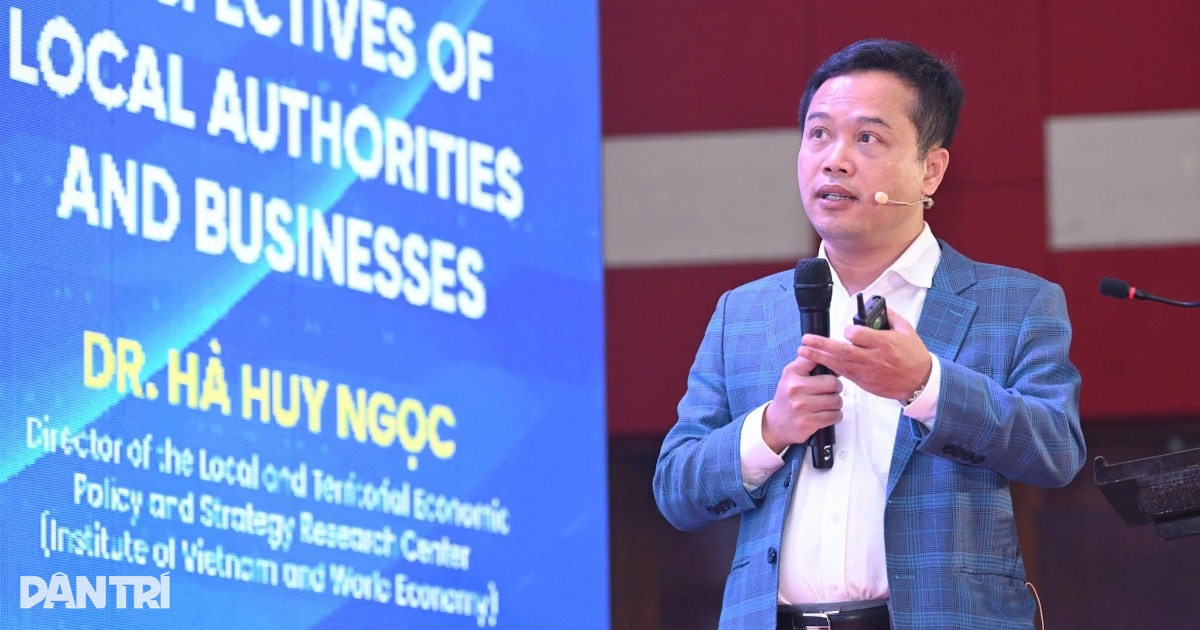
On November 26, the Dân trí newspaper organized the seminar “Implementing ESG with Science and Technology – From Awareness to Action” in Hanoi.
In his presentation on ESG transformation from the perspective of local authorities and businesses, Dr. Ha Huy Ngoc, Director of the Center for Research on Local and Territorial Economic Policies and Strategies (Vietnam Institute of Economics and World Affairs), outlined the numerous pressures faced by small and medium-sized enterprises (SMEs) in Bac Ninh on their green transition journey.
From this, he offered specific proposals for ESG implementation.
According to Dr. Ngoc, given its characteristic as a key industrial province, SMEs in Bac Ninh face pressure not only from international partners but also internally, as sustainable development requirements increasingly become a condition for maintaining competitiveness.
Major Obstacles Stem from Costs and Human Resources
According to Dr. Ngoc, survey results on factors impacting ESG in Bac Ninh indicate that most businesses encounter difficulties with even the most basic ESG requirements.
“Compliance costs are the first and largest barrier. Businesses must invest in wastewater treatment systems, install automatic monitoring systems, implement ISO 14001 – 45001 standards, and compile CO₂ emission reports. These are items that many SMEs lack the resources to implement,” Dr. Ngoc pointed out.
A shortage of dedicated personnel is also a common issue. Virtually no SMEs have an ESG Manager or a Sustainability Office. This lack of human resources leads to a deficit in processes and proper ESG operational mechanisms.
The absence of digital data is the next barrier. Businesses lack emission management software and cannot provide data for supply chains to large corporations that demand full product lifecycle transparency.
“When we visited local areas, not only local authorities but also businesses faced a lack of data, especially real-time data. For example, data on wastewater, waste, and the number of operating businesses,” Dr. Ngoc clarified.
Finally, the significant gap between Foreign Direct Investment (FDI) enterprises and domestic businesses makes it even harder for SMEs to keep up. FDI enterprises have very high requirements and complete ESG systems, whereas domestic businesses lack the financial capacity, human resources, and technology to respond quickly.
Integrating ESG into Planning: A Key Step
Based on the analysis, Dr. Ngoc emphasized that one of the most crucial elements for current ESG transformation is data. Most importantly, it needs to be accurate, sufficient, clean, live, and uniformly shared data.
“A complete dataset is essential for ESG transformation. Without sufficient data, nothing can be done. Current data is not only incomplete but also fails to reflect real-time situations, making it impossible to see an accurate picture of what is happening at the present moment,” Dr. Ngoc stressed.
Additionally, according to Dr. Ngoc, integrating ESG into provincial and industrial park planning is a particularly necessary step if Bac Ninh wishes to maintain its role as an industrial hub and participate more deeply in global supply chains.
Specifically, Dr. Ngoc highlighted that the province needs to make ESG a mandatory criterion when approving new industrial parks, only accepting models with water circular systems, renewable energy use, and a focus on ecological industrial parks. Concurrently, a mechanism for ranking industrial parks based on ESG indicators should be established to encourage continuous improvement.
Regarding businesses, the province can provide support by simplifying procedures, reducing certification costs, and prioritizing access to tenders, land leases, and credit for entities that meet ESG criteria well.
One of the important solution groups is investing in smart monitoring systems, industrial waste and wastewater treatment infrastructure, and a green power grid. These are prerequisites for businesses to have a foundation for ESG implementation without bearing the entire cost themselves.
Dr. Ha Huy Ngoc assessed that ESG is not just a pressure but also opens opportunities for Bac Ninh to upgrade the quality of industrial development, create a competitive advantage in attracting responsible investment, and meet international standards.
According to him, ESG implementation must become a long-term strategy, guided synchronously from government to businesses.