The wave of debate surrounding alleged plagiarism in designer Cao Minh Tien’s latest collection has not only focused on copyright issues but has quickly shifted towards professional ethics and transparency within the creative arts.
The incident occurred during Vietnam International Fashion Week Fall-Winter 2025, when designer Cao Minh Tien unveiled his Sleepwalker collection. Several of his designs were accused of plagiarizing another brand. These included shirts with tattoo-like patterns, which had previously gained popularity with local brand D. several years ago.
Designer Cao Minh Tien admitted to purchasing a shirt with tattoo-like patterns from an e-commerce platform to incorporate into his collection. The image shows Cao Minh Tien’s design on the left and Brand D.’s product on the right. (Photo: Nguyen Ha Nam – Screenshot).
Under public pressure, designer Cao Minh Tien admitted to buying several products from an e-commerce platform to mix into his designs, and apologized to the brand for not obtaining consent. However, this did not quell the negative reactions from fashion enthusiasts.
On social media, many expressed disappointment and questioned the working methods of the veteran designer.
One Threads user commented: “As a creative, designer Cao Minh Tien, more than anyone, should understand that copyright and intellectual property are the most basic things to respect. There was no thorough research, meticulous exploration, and genuine creativity to bring a professional collection to Vietnamese fashion here…”
Some other opinions expressed surprise: “I can’t believe a veteran designer would let such a thing happen”; “I didn’t think a designer could be so unprofessional…” Some even felt disheartened: “I used to admire Cao Minh Tien for his TikTok food review clips and his approachable, sincere personality. Now it’s hard to see him the same way…”
What are ‘stock patterns,’ and are designers allowed to use them?
In an interview with Dan Tri reporters, a fashion expert noted that this story goes beyond merely using another brand’s design for one’s own collection, touching upon a deeper issue: the standard of creativity and the level of professionalism expected from a designer.
According to the expert, in the fashion industry, the concept of “stock designs” (ready-made patterns and decorations sold on online platforms) is not new.
“The use of ready-made pattern materials does not violate the law if the user properly acquires the copyright. However, this is considered highly taboo for collections presented on major stages, especially when associated with the name of a long-standing designer,” the fashion expert stated.
“Fashion is an industry of creativity. Patterns are the soul of an outfit. If the most important part is taken from a stock pattern library or purchased from another’s product, the design loses its unique identity. That is unacceptable for a professional designer,” the expert added.
The expert also clarified that professional designers are allowed to use ready-made patterns inspired by cultural and historical sources, such as Dong Son drum patterns or Dong Ho paintings, as these are considered public communal assets. However, patterns designed by someone else are the creative property of a specific individual.
Therefore, using ready-made pattern materials for a runway collection can easily lead to debates about professional ethics, even without copyright infringement.
This expert believes that in specialized training, students are not allowed to use stock patterns for their graduation projects. The reason is that instructors require projects to demonstrate independent creative thinking.
“If a final-year student isn’t allowed to use stock patterns, then a designer with many years in the profession using ready-made pattern materials raises even more questions from the public,” the expert pondered.
Where is the artistic creativity?
Another fashion expert expressed strong disapproval of such an easygoing approach to artistic creation, which he considered a violation of professional ethics.
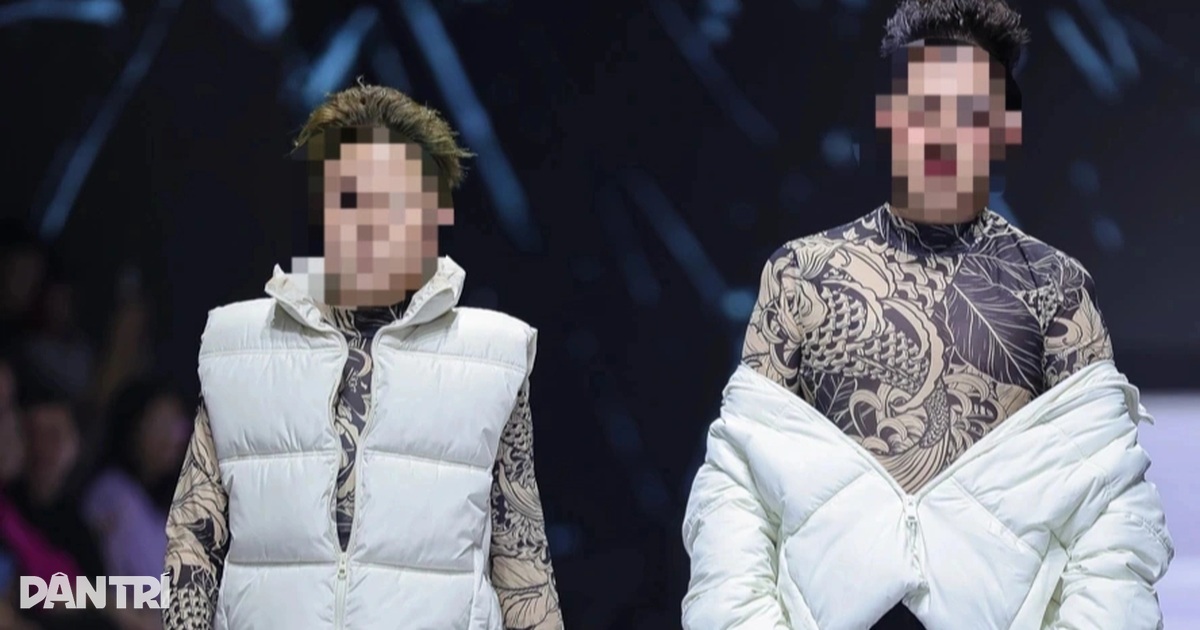
Two similar designs from Cao Minh Tien’s “Sleepwalker” collection, showcased by actors Bao Han and Quang Anh at Vietnam International Fashion Week Fall-Winter 2025. The inner shirt with tattoo-like patterns resembles Brand D.’s product (as admitted by designer Cao Minh Tien), the outer puffer jacket is from Brand G., and only the skirt is by designer Cao Minh Tien. (Photo: Nguyen Ha Nam).
“Designer Cao Minh Tien’s Sleepwalker collection was a display of artistic creation, not a commercial product. Therefore, the element of creativity must be paramount. So, if a designer buys clothes online to patch together into a new product, where is the creativity? I believe mixing and matching outfits is the job of a stylist, not a designer,” he stated.
The expert pointed out that in two similar designs worn by actors Bao Han and Quang Anh on the Fashion Week stage, the inner shirt with tattoo-like patterns was a product of Brand D. (as admitted by designer Cao Minh Tien), and the outer puffer jacket was from Brand G. Only the skirt worn underneath was designed by Cao Minh Tien.
“Modern fashion encourages designers to recycle old products, aiming for sustainability, but recycling is a process of treating and transforming materials into new products, not directly taking someone else’s item and presenting it as one’s own creation,” the expert clarified.
The expert gave an example: some designers use the technique of cutting and patching old jeans to create a new handbag. That is creativity because the public no longer recognizes the original product. However, incorporating an entire product from another brand into one’s own design is hard to accept in artistic creation.
Notably, the Sleepwalker collection was placed in the closing position (vedette) – the most prestigious slot at a fashion week. This implies that the show had given special preference and high regard to this designer’s name, contributions, and creativity.
Therefore, the expert questioned the professional quality of the program itself!
Fashion designs are protected under intellectual property rights.
Copyright protects artistic works, including creative and unique fashion designs. According to intellectual property law, copyright is automatically established once a work is created and does not require registration.
Copyright protection lasts for the author’s lifetime and extends for 50 years after the author’s death. If a work is created by multiple authors, the protection period is calculated from the death of the last surviving author.
Copyright protects the artistic elements of a fashion design, such as patterns, colors, structure, and the arrangement of these elements. However, copyright does not protect ideas, concepts, or styles that the design embodies.